The Shield of the Americas: Trump reconfigures drug war to kick China out of Latin America
Created Wednesday 01 April 2026
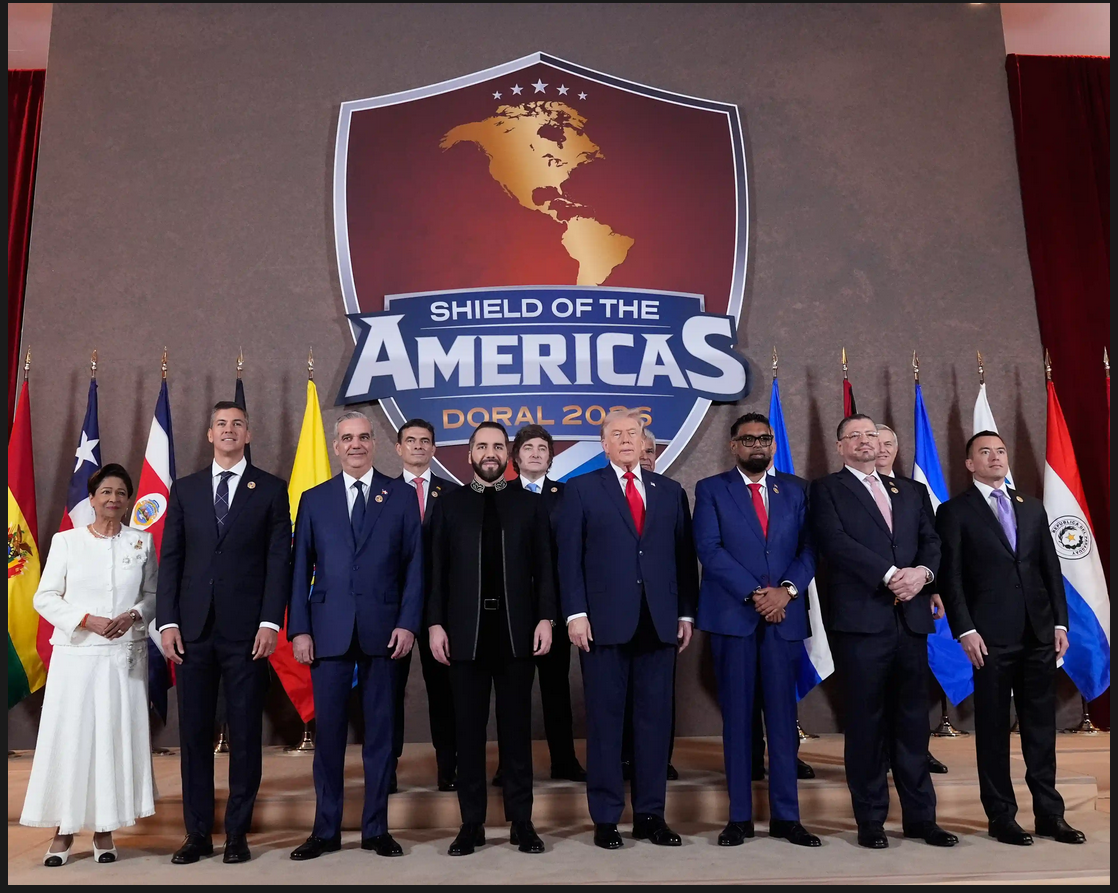
Trump & Latin America's top right wing sycophants
Building on his successful "drug war" mission against Venezuelan, Trump inaugurated his Shield of the America initiative in early March. Obstinately to expand his anti-narco terrorism strategy, part of the so-called Donroe Doctrine, to the rest of the hemisphere.
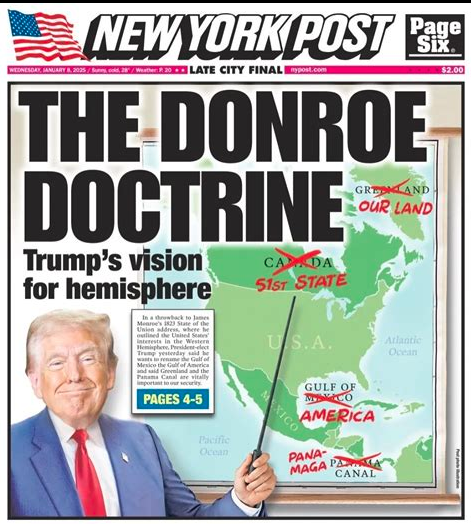
Truth be told, drugs don't really have much to do with it. It is just a naked grab for imperial power in the region by the US. In particular, a counter to Chinese penetration into the region. Infrastructure and flows of goods and resources, legal and illegal, dominate US thoughts (Salon & Project 2025 p.154 & p183-184).
Despite the Americas Counter Cartel Conference declarations (press release), Trump's actions over the last year in the region suggests drug interdiction is not a main concern. Maduro is gone, but Venezuela was never a real source of cocaine, that's Colombia. Ecuador, the US's newest drug war ally in Latin America, meanwhile, has a President whose company is implicated in cocaine trafficking. He remains in power with US blessing. Meanwhile, Trump released ex-Honduran president, Juan Orlando Hernandez, from a US jail. His crime, cocaine smuggling into the US. The contradictions go on.
They always have when it concerns US drug interdiction policy. The national interest always takes precedent. And that basically means the promotion of capitalism (McCoy). The drug war narrative cloaking the US' naked imperialism to a domestic audience worn down by foreign entanglements.
The drug war fight plays well in Latin American too. Especially in nations suffering from an upswing in drug related-violence. Traditionally, the worst effected had been Brazil, Colombia and Mexico, those not at the conference due to their centre-left liberal governments. But as the political right has re-asserted itself around the region, drug wars have spread region wide.
In response, a la Plan Colombia and the Merida Initiative, these nations have turned to US style interdiction. These don't tackle the root causes of drug wars. Cartels are just a symptom after all. The increasing inequality generated by free trade and financialisation of the world under capitalism is the structural issue.
Drug interdiction allows states to counter this contradiction in numerous ways, but we will focus on two here. First, paralysed by fear, citizens welcome increased interdiction and the militarisation that comes with it. And, as economic security becomes linked to preventing state failure, democratic accountability lessens. Allowing states to double down on more free trade and finacialisation, taking decisions behind closed doors for security reasons.
Second, states can, though these strategies, manage cartels. Cartels develop new parallel roles (security, taxes, welfare) and markets (drugs, agricultural, people) to the state. These can be later integrated into the wider circuits of global capitalism once the cartels have removed any resistance (land defenders, indigenous populations, journalists, politicians). If a cartel becomes too big and threatens the state, the leadership is removed, fragmenting the organisation.
The kingpin strategy is the standard here. The emblematic example is Escobar and the Medellín cartel. Escobar's mistake was to threaten to pay off Colombia’s national debt. Removing this would have released the nation from its dependency to foreign capital. An existential threat to the capitalist state and political classes running it. Primarily, as they would no longer be able to justify the continued oppression and exploitation of the majority (Villar & Cottle). More recently, was El Mencho, the now deceased leader of the Jalisco Cartel in Mexico. His crime, working too close to the Chinese when the US wants the Asian powerhouse out of Latin America.
Which brings us back to the original point of this article. To note the US leveraging of drug interdiction for its current obsession. Re-asserting its hegemony over the Western Hemisphere by ousting China from the region.
- read more: Tooze on China's strategy