
Board of Deputies alliance with Reform signals authoritarian shift in the UK
Created Tuesday 12 May 2026
Anti-Semitism rally's shenanigans demonstrate the British state's growing acceptance of Farage's far-right project. Where will that leave liberal democracy in the UK?
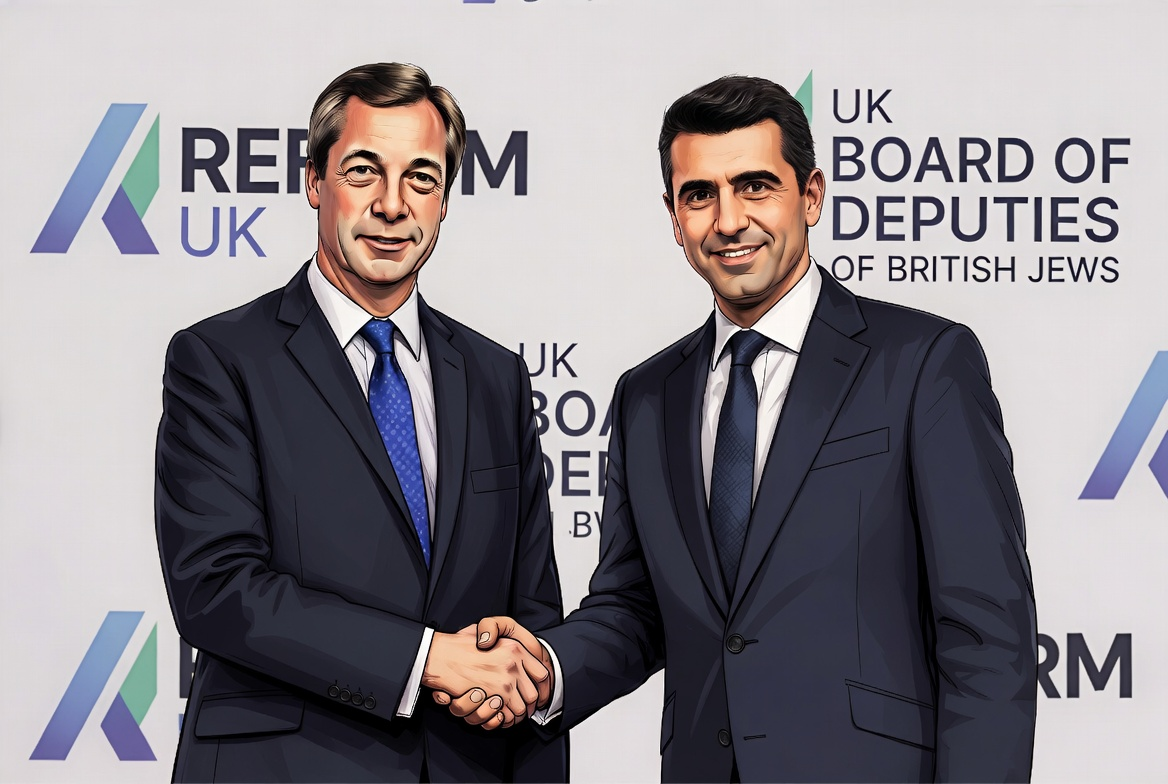
(AI generated image)
Over the weekend, a whole host of organisations held an anti-Semitism rally in London. The only problem? Who they invited. Nigel Farage. He leads the UK's most electorally successful far-right nationalist party and has also faced accusations of anti-Semitism. Meanwhile, they ignored Zack Polanski, the Jewish leader of the left-wing Green Party.
The contradiction was obvious from the start. Haaretz notes that 2,000 British Jews signed an open letter criticising the move. Nevertheless, the organisers didn’t back down. In the same Haaretz article, the CEO of the Board of Deputies of British Jews, Michael Wegier, justified the decision. He pointed to Reform's growing influence in British politics, support for the party among some British Jews and Reform's stated commitment to fighting anti-Semitism. In a telling shift, he then castigated Polanski for allegedly failing to root out anti-Semitism in the Green Party.


Wegier's response makes little sense until you recognise that the Board of Deputies is bound by its constitution "...to advance Israel's security, welfare and standing". The suspension last year of five deputies for writing an open letter critical of Israel demonstrates the organisation's sustained structural bias towards Israel.
In this light, the Board's understanding of anti-Semitism appears increasingly inseparable from support for Israel.
This may explain why, back in 2020, Amanda Bowen, Vice-President of the Board of Deputies, publicly condemned Farage for his anti-Semitism. At the time, Farage and his UKIP party seemed like a spent force in UK politics. By attacking Farage, despite his pro-Israel position, the Board could rebut claims that it was weaponising anti-Semitism against anti-Zionist and pro-Palestinian currents in the Labour Party. It was a strategy that helped crush the party's left as it moved right under leader Keir Starmer, the current Prime Minister,
But as the Labour Party surrendered its left flank, the Green Party moved into it under the leadership of Polanski in 2025. It now shared with the Labour left an anti-Israel ethical foreign policy and what it described as "...clear left-wing socialist green..." politics. Meanwhile, in early 2026, Farage's new electoral vehicle, Reform, surging in the polls, also made its support for Israel increasingly explicit. Despite Reform's anti-immigrant politics and rhetoric, which many critics regard as racist, the Board of Deputies warmed to Farage's advances.
What troubles me more than this growing rapprochement between the Board of Deputies and the far right is what it signals for British liberalism. Sections of the British elite are now accepting Farage’s mini-Trump project. Liberalism in the UK is changing. The globalist neoliberals who fought Farage’s petty-bourgeois nationalists over Brexit are joining forces.
This is not as contradictory as it first appears. When capitalism stagnates and legitimacy collapses, liberal institutions historically have turned to authoritarian nationalism. Liberal capital and the nationalist right start to converge.
And with the continued support of a disenfranchised and polarised public, the kind of institutional transformation already visible in Trump's second term will arrive in the UK too. When it does, it will bring intensified attacks on the welfare state, particularly in health care and education. At the same time, equality protections, civil liberties and democratic institutions that constrain executive power will also be hollowed out in favour of an authoritarian state.