Copaganda, race & hegemony
Created Tuesday 30 September 2025
How Copaganda works, some history.
Copaganda in brief, is media that portrays the police as a societal good. It also tends to downplay the role they play in sustaining capital.
In the academy the role of the media as propaganda has often been analysed from Gramcsi hegemony position. Here the media is used by the elites to communicate the correct social norms to society and create society wide consensus.
Vivek Chibber, thought, believes Gramcsi ideas on hegemony are often misread. He asks, were people conned into thinking that neoliberalism was good? No, most know capitalism sucks. But due to the material reality of de-industrialisation and union weakness, they accepted it.
Now there is plenty of criticism of this view. Namely, it limits class relations to its materialist variables. This ignores the wider social relations that also go into defining capitalist relations.
Therefore, while Chibber's view, in terms of those that come off worse in capitalism, the working and under-classes classes, he is correct. It is not there to brainwash them. Yet his limited analysis means that he misses other social variables, and in the case of the US and Hollywood, race is important too.
This is something Cabaral does in her historical dissection of racial Hollywood. She posits that Hollywood creates a guide to whiteness and how new migrants can integrate into US society.
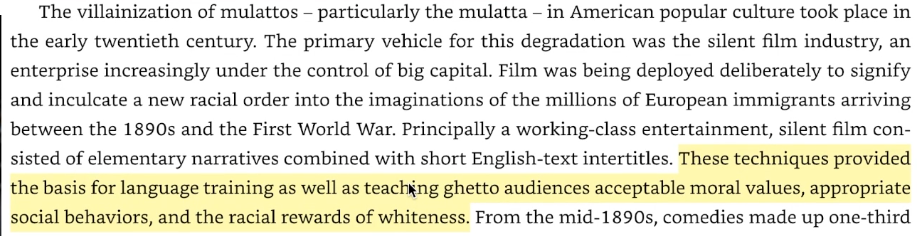
Cabral continues that Hollywood justifies and explains the elite racial strategy of the US. A division of society driven by elite reaction to increasing class consciousness between workers of different races
The legal strategy to break this alliance, in the US south, were the Jim Crow laws. Today Copaganda still transmits these same elite racist values.
Furthering this idea, Jared Ball notes, in his review of One Battle After Another, that most cinema is a reflection of the white author fantasy. A reflection of the director's trauma and concern over the threat from the black community.
Quoting Rosa Salas, Ball notes that the reason for this perspective nowadays is to make a connection with the actual target audience, white affluent Americans. To reinforce whites sense of colonial superiority and whiteness. To make them feel better about the position of blacks in the country.
In conclusion, and returning to Chibber, what he fails to note is that some groups have and still thrive under capitalist structures. Under the racial capitalism of the US, the media talks to the citizens who achieve "whiteness".
Hollywood messages them to ignore the material inequalities that are obvious. Not directly building a consensus for capitalism, but to sustain racial divisions. Divisions that prevent the re-emergence of a politics of inter-racial class war.
And copaganda, as a part of the US entertainment industry, seeks to do just that.