Created Wednesday 01 April 2026

Trump & Latin America's top right wing sycophants
Building on his successful "drug war" mission against Venezuela, Trump inaugurated his Shield of the Americas initiative in early March. The goal, ostensibly, was to expand his anti-narco terrorism strategy, the so-called Donroe Doctrine, to the rest of the hemisphere.
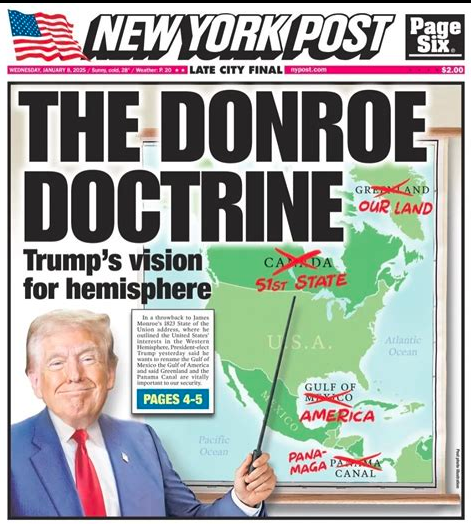
In practice, drugs have little to do with it. The Shield of the Americas is less an anti-drug initiative than a geopolitical project designed to curb Chinese influence in Latin America under the cover of a militarised enforcement policy. Beneath the rhetoric lies a familiar objective: the reassertion of US imperial power in the hemisphere. Infrastructure and trade flows, both legal and illicit, increasingly dominate US strategic thinking (Salon & Project 2025 p.154 & p183-184).
Despite the Americas Counter Cartel Conference declarations (press release), Trump's actions over the last year in the region also suggest that drug interdiction is not the top priority. Maduro is gone, but Venezuela was never a real source of cocaine; the principal producers are Colombia, Peru and Ecuador. Before that Trump released ex-Honduran president, Juan Orlando Hernandez, from a US jail. His crime: cocaine smuggling into the US. Meanwhile Ecuador, the US's newest anti-drugs strategy partner, has a president whose company is implicated in cocaine trafficking. He remains in power with US blessing.
The contradictions go on; they always have when it concerns US anti-narcotics policy. The national interest always takes precedence, particularly the preservation of an economic order favourable to US capital and its allies (McCoy). The anti-drug narrative cloaks the US's geopolitical goals to a domestic audience worn down by foreign entanglements.
Yet, the audience in the targeted nations is also an issue, wary of foreign military intervention. The counter-narcotics rhetoric, however, plays well in Latin America, especially in nations suffering from an upswing in related violence. Traditionally, the worst affected have been Brazil, Colombia and Mexico, the very countries not at the conference due to their centre-left liberal governments. But as the political right has reasserted itself around the region, rising violence has generated more legitimacy for hard-line prohibition policies.
In response, à la Plan Colombia and the Mérida Initiative, these nations have turned to US-style interdiction. These policies do not tackle the root causes of the drug trade. Drug trafficking organisations (DTOs), commonly referred to as cartels, are a symptom rather than the cause. The structural issue lies in the growing inequality generated by free trade and the financialisation of the global economy under capitalism.
Drug prohibition, though, allows states to counter this contradiction in several ways. First, paralysed by fear, citizens often welcome increased militarised interdiction. As economic security becomes tied to preventing state failure, democratic accountability weakens. This allows states to deepen free trade integration and financialisation while shifting major decisions behind closed doors under the banner of security.
Second, states can, through these strategies, manage DTOs. These criminal organisations often develop parallel governing functions — security provision, taxation, and welfare distribution — alongside markets in narcotics, agriculture, and human trafficking that compete with or supplement the state. As critical scholarship on development and the illegal drug sector has shown, DTO violence often suppresses resistance from land defenders, indigenous communities, journalists, and political opponents, facilitating the later integration of these territories into wider circuits of global capitalism. If a DTO grows powerful enough to threaten the state itself, its leadership is removed, fragmenting the organisation.
The kingpin strategy remains central to this approach. The most emblematic case is Pablo Escobar and the Medellín cartel. Escobar’s growing economic and political influence increasingly threatened the relationship between the Colombian state, domestic elites, and foreign capital. His proposal to pay off Colombia’s foreign debt symbolised a challenge to the country’s dependency on external finance and the political order built around it. For political elites, such a rupture threatened the economic structures through which inequality and social control were reproduced (Villar & Cottle).
A more contemporary example from 2026 is El Mencho, the now deceased leader of the Jalisco Cartel in Mexico. His crime, from Washington’s perspective, was his close integration into Chinese trade networks: importing fentanyl from China and enabling the exploitation and exportation of iron ore back to the same power the US wants out of the region.
Shield of the Americas therefore represents more than a renewed interdiction strategy. It is the latest attempt to reassert US hegemony in the Western Hemisphere at a moment when Chinese capital, infrastructure, and trade networks have begun to challenge Washington’s traditional dominance in the region.
Read more: Tooze on China's strategy